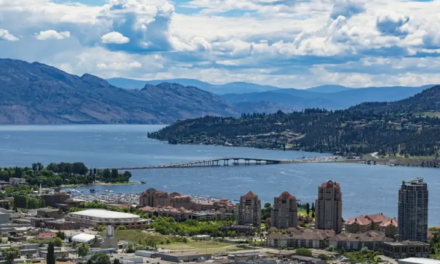

KELOWNA, BC – As the immediate wildfire threat eases across parts of the Okanagan, attention is shifting from evacuation and suppression to recovery.
For many families, that recovery will take much longer. Homes, belongings and a sense of security have been lost or disrupted. For those directly affected, discussions about property markets and values can understandably seem distant.
But successive fires across the Okanagan and British Columbia’s Interior are forcing a broader conversation.
Wildfire preparedness is becoming part of owning property in the BC Interior.
Not every community will experience a major fire every year. But wildfire season has become a recurring annual risk that homeowners, insurers, lenders, builders and buyers increasingly need to consider.
That changes the discussion from simply responding to fire to building, renovating and maintaining property differently before the next event.
FireSmart principles begin with the home and the immediate area around it. Fire-resistant roofing, non-combustible siding, screened vents, appropriate glazing and careful treatment of decks, fencing and landscaping can reduce vulnerability to embers and radiant heat.
Some of the most effective measures are straightforward: keeping roofs and gutters clear, moving firewood away from structures and reducing combustible material and vegetation immediately beside buildings.
Insurance is increasingly part of the same discussion.
Insurers are paying greater attention to wildfire exposure, building characteristics, access to fire protection and mitigation measures. FireSmart assessments and documented improvements may help distinguish the risk profile of one property from another.
That raises an important real estate question:
Will buyers increasingly distinguish between properties and communities that are demonstrably prepared for wildfire and those that are not?
Research in other wildfire-prone markets is examining whether stronger construction standards and mitigation measures are reflected in sale prices. British Columbia should be cautious about applying those results directly, but the principle deserves attention.
Buyers may increasingly ask: How was the home constructed? Has mitigation work been completed? Can it be readily insured? How is surrounding vegetation managed? What water, road access and emergency infrastructure serve the neighbourhood? How prepared is the community?
Those questions can influence insurance costs, financing, buyer confidence, marketability and ultimately value.
Wildfire resilience operates at two levels.
The first is the individual property, where construction materials, landscaping, maintenance and FireSmart measures can reduce vulnerability.
The second is the community, where road access, evacuation capacity, water systems, vegetation management and emergency response can shape how residents, insurers and purchasers perceive risk.
A well-prepared home cannot eliminate the risk created by an inadequately prepared neighbourhood. Conversely, communities that systematically reduce wildfire exposure may gain an advantage over otherwise similar locations.
Wildfire risk cannot be eliminated. But it can be better understood, reduced and managed.
For property owners across the BC Interior, preparedness is becoming part of normal property stewardship rather than something considered only when smoke appears on the horizon.
Over time, resilience may become another characteristic the market recognizes when distinguishing one property, neighbourhood or community from another.
That may be one of the most important property lesson left after the flames.
Tim Down, CCIM, RI | Commercial Real Estate Advisor, NAI Commercial Okanagan