

KELOWNA, B.C. – The Central Okanagan’s economy showed mixed signals in the second quarter of 2026, as a surge of new job seekers outpaced hiring even wile the region’s workforce, employment and airport traffic all grew, according to figures released by the Central Okanagan Economic Development Commission.
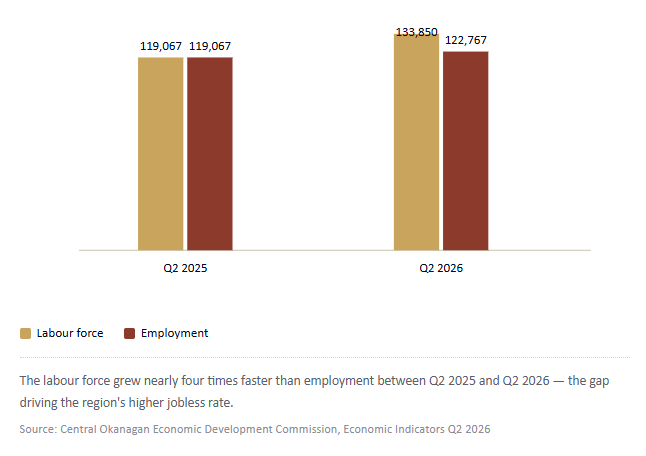
The region’s labour force climbed to 133,850 people in the April-to-June period, up 12.4 per cent from 119,067 a year earlier. Employment also rose, but at a much slower pace, up 3.1 per cent to 122,767 jobs. Because the pool of job seekers grew faster than the number of available positions, the unemployment rate rose to 8.3 per cent, up from 6.1 per cent in the same quarter last year – an increase the commission attributes to more people actively entering or re-entering the workforce.
Employers posted 11,632 job openings in the first half of 2026, down slightly – 1.4 per cent – from 11,799 postings during the same stretch in 2025. Sales and service positions accounted for the largest share, with 3,825 postings, followed by trades, transport and equipment operator roles at 1,711, and business, finance and administration jobs at 1,611.
Housing Starts Fall Sharply
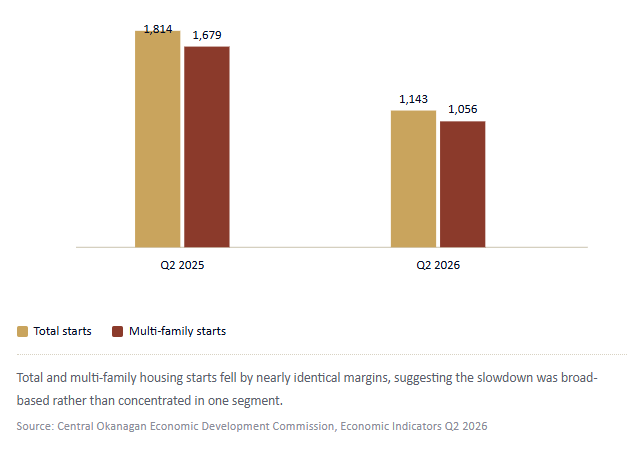
Residential construction, meanwhile, slowed considerably. Housing starts fell 37 per cent, to 1,143 units from 1,814 a year earlier. Multi-family construction, which continues to make up more than 90 per cent of all housing starts in the region, dropped by a similar margin, falling to 1,056 units from 1,679.
Despite the pullback in new construction, the value of building permits issued remained relatively strong. Permits totalled roughly $622.8 million in the second quarter, down 5.7 per cent from $660.5 million a year earlier, but still 7.3 per cent higher than the same period in 2024.
Airport Traffic Keeps Climbing
Air travel continued to climb. Kelowna International Airport recorded 558,150 passengers in the quarter, a 7.7 per cent jump from 518,023 the year before. The commission credited the increase to steady demand for business and leisure travel, expanded airline connectivity – including Porter Airlines’ new direct route to Ottawa – and high-profile events such as the Memorial Cup and Kelowna HOOPFEST. The airport is coming off a record year in 2025, when it handled 2.3 million passengers, and officials say expanded seat capacity, larger aircraft and terminal upgrades have reinforced its role as the main air gateway to B.C.’s Interior.
Home Prices Outpace Toronto
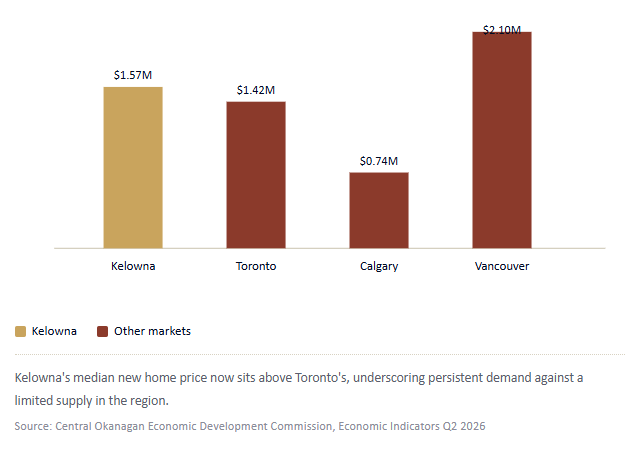
Housing affordability also remains a defining issue for the region. The median price of a new home in Kelowna reached $1,565,000 in the second quarter, placing it above Toronto’s $1,420,000 median and well ahead of Calgary’s $735,000, though still below Vancouver’s $2,100,000.
Looking Ahead
The commission described the overall economic picture as one of resilience, pointing to sustained growth in the labour force, employment, and air travel as signs the region remains attractive to residents, businesses and investors. It acknowledged, however, that rising unemployment and a slowdown in housing starts point to a period of adjustment as the local economy works through shifting market conditions heading into the second half of the year.